
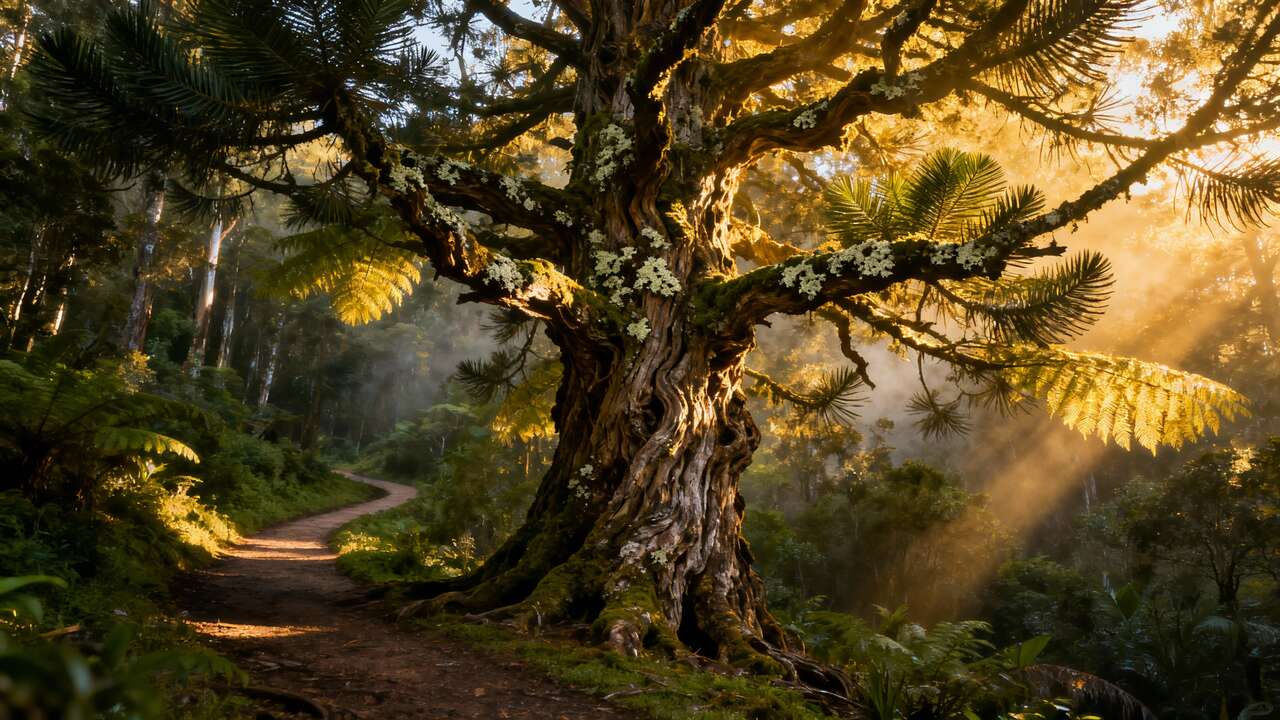

In a remote canyon of an Australian national park, a species thought to have vanished with the dinosaurs was found thriving in secret. This “living fossil, ” a direct link to the Jurassic period, has captivated scientists and the public alike. Its rediscovery is a story of chance, secrecy, and a monumental effort to save a relic from the dawn of time. The tree’s survival for over 200 million years is a testament to its resilience, yet its future now hangs precariously in the balance, threatened by modern dangers its ancestors never faced.
The dinosaur tree: a remarkable discovery
A chance encounter in the wild
The story of the Wollemi pine, Wollemia nobilis, began in 1994. A park officer exploring a remote, rugged canyon system within the Wollemi National Park, just 150 kilometers from Sydney, stumbled upon a grove of unusual trees he did not recognize. With their distinctive bubbly, dark brown bark and fern-like foliage arranged in neat rows, these conifers were unlike anything known in modern botany. It was later confirmed that this was not just a new species but a new genus, belonging to the 200-million-year-old Araucariaceae family. It was a plant that scientists had only ever seen in fossil records, leading to its popular nickname: the dinosaur tree.
The significance of a living fossil
The discovery was the botanical equivalent of finding a living dinosaur. It provided a tangible link to the ecosystems of the Mesozoic Era. Before this, the Wollemi pine was believed to have gone extinct approximately two million years ago. The surviving wild population consists of fewer than 100 mature trees, making it one of the rarest plants on Earth. This tiny, isolated population represents an unbroken genetic line stretching back millions of years, offering invaluable insights into plant evolution and the ancient climate of the supercontinent Gondwana. Its survival through ice ages, climate shifts, and continental drift is a remarkable feat of natural endurance.
| Feature | Description |
|---|---|
| Scientific Name | Wollemia nobilis |
| Family | Araucariaceae |
| Discovery Year | 1994 |
| Native Location | Wollemi National Park, Australia |
| Status | Critically Endangered |
| Fossil Record | Extends back over 200 million years |
This incredible find immediately raised urgent questions about how to protect such a small and vulnerable population, sparking one of the most significant conservation efforts in botanical history.
The challenges in conserving the Wollemi pine
Genetic vulnerability and bottleneck
One of the most pressing challenges for the Wollemi pine is its extremely limited genetic diversity. Scientific analysis has revealed that the entire wild population is virtually genetically identical, suggesting the species went through a severe population bottleneck at some point in its past. This lack of variation makes the trees highly susceptible to threats. A single disease or a specific environmental stressor could potentially wipe out the entire wild grove. Without the genetic toolkit to adapt, the species’ natural ability to evolve and respond to new pressures is severely compromised. This genetic uniformity is a fragile inheritance from a long and solitary existence.
Threats from pathogens and human activity
The isolation that protected the Wollemi pine for millennia is now a source of vulnerability. The trees have no evolved resistance to modern pathogens. The introduction of foreign diseases is a major concern, particularly the water mold Phytophthora cinnamomi. This devastating plant pathogen causes root rot and can be easily transported on the soles of shoes. To mitigate this risk, the exact location of the wild grove is a closely guarded secret. Unauthorized visitors pose a direct threat, not only by potentially introducing diseases but also by physically damaging the fragile habitat. The conservation strategy, therefore, hinges on a delicate balance of scientific study and strict biosecurity protocols.
- Biosecurity Risk: Introduction of pathogens like Phytophthora cinnamomi.
- Fire: Increased frequency and intensity of bushfires.
- Climate Change: Shifting weather patterns affecting the microclimate of the canyon.
- Genetic Bottleneck: Lack of diversity to adapt to new threats.
Beyond pathogens, the species faces an even more elemental danger that became terrifyingly real in recent years.
A prehistoric tree under threat: protecting the Wollemi pine
The trial by fire
During Australia’s catastrophic “Black Summer” bushfires of 2019-2020, the last wild stand of Wollemi pines faced an existential threat. As the massive Gospers Mountain fire encroached upon the secret canyon, a clandestine and unprecedented environmental rescue mission was launched. Specialist remote-area firefighters were winched down from helicopters to establish an irrigation system to keep the canyon floor damp. Large air tankers dropped fire retardant to create a protective shield around the grove. This extraordinary effort successfully saved the ancient trees from incineration, highlighting the immense value placed on their survival and the extreme measures required to protect them.
A global propagation program
Recognizing that concentrating all conservation efforts on a single, vulnerable location was too risky, authorities initiated a global propagation program. Starting in the early 2000s, cuttings from the wild trees were carefully cultivated in nurseries. The goal was twofold: to create a secure “insurance population” away from the original site and to satisfy public curiosity without endangering the wild grove. By making legally cultivated Wollemi pines available for sale to botanical gardens and the general public, the program reduced the incentive for illegal collectors to seek out the wild specimens. This strategy effectively turned plant lovers around the world into custodians of the species.
This distribution has transformed the Wollemi pine from a hidden Australian secret into a shared piece of global heritage.
The Wollemi pine: a global treasure to preserve
An ambassador for conservation
The Wollemi pine has become a powerful global symbol for plant conservation. Its incredible story of survival and rediscovery captures the imagination in a way few other species can. It serves as a flagship species, drawing attention to the broader issue of biodiversity loss and the importance of protecting critically endangered flora. Botanical gardens from London to New York proudly display their Wollemi pines, using them as educational tools to tell a story about extinction, evolution, and the critical role of conservation science. Each tree planted outside Australia acts as a living backup, a distributed network safeguarding the species’ genetic legacy.
The role of botanical gardens
Botanical gardens play a crucial role in the long-term survival strategy for the Wollemi pine. They provide secure, controlled environments where the trees can be grown, studied, and preserved for future generations. These institutions form a global network for ex-situ conservation, meaning the preservation of a species outside its natural habitat. This network not only protects the species from threats facing the wild population but also facilitates research into its biology, propagation techniques, and potential vulnerabilities. The data collected from these cultivated specimens is invaluable for informing the management of the original wild grove.
The success of these global efforts provides a hopeful blueprint for the species’ continued existence, yet its long-term outlook remains a subject of intense scientific focus.
The future of the dinosaur tree
Building resilience through research
The future of the Wollemi pine depends heavily on ongoing scientific research. Scientists are focused on understanding the tree’s unique biology, its reproductive cycle, and its specific habitat requirements. A key area of study is cryopreservation, where seeds and tissue are frozen in liquid nitrogen to be stored for centuries. This provides a long-term genetic safeguard against catastrophic loss. Additionally, researchers are exploring the possibility of carefully planned translocations, establishing new, secret populations in similar canyon environments to spread the risk. These efforts aim to build resilience into a species that has, until now, relied solely on isolation for its survival.
Public participation and awareness
The decision to release the Wollemi pine to the public was a calculated risk that has largely paid off. By allowing people to purchase and grow their own “dinosaur tree, ” the program has fostered a sense of collective ownership and responsibility. It has also proven that the tree is surprisingly hardy and adaptable to a wide range of climates, from cool temperate to subtropical. This widespread cultivation ensures that even if the wild population were to perish, the species itself would not become extinct. The program demonstrates a modern conservation model where public engagement is not just a side effect but a central component of the strategy.
The survival of this Jurassic witness is not just a botanical curiosity; it has profound implications for our understanding of Earth’s deep past and the ecosystems of today.
Ecological impacts of a Jurassic witness
A window into ancient ecosystems
The Wollemi pine is more than just an old tree; it is a time capsule. Studying its genetics, physiology, and the microorganisms it coexists with provides unparalleled insights into the ecosystems of the Jurassic period. It helps scientists understand how ancient conifers competed and survived in a world dominated by dinosaurs and a vastly different climate. Its unique features, such as its ability to sprout multiple trunks (a process known as coppicing), may be an adaptive trait that helped it survive millennia of environmental changes. It is a living laboratory for studying long-term evolutionary processes and planetary history.
Lessons for modern conservation
The story of the Wollemi pine offers critical lessons for modern conservation. It highlights the importance of:
- Exploration: Undiscovered species may still exist in remote, unexplored areas.
- Biosecurity: Protecting vulnerable populations from introduced diseases is paramount.
- Integrated Strategy: Combining in-situ (on-site) protection with ex-situ (off-site) cultivation is a powerful model for saving critically endangered species.
- Public-Private Partnership: Engaging the public can create a global network of custodians.
The combination of strict secrecy for the wild site and open commercialization for cultivated plants is a novel approach that could be applied to other rare species. It balances the need for protection with the power of public awareness and participation, creating a robust and multi-layered defense against extinction.
The rediscovery and ongoing protection of the Wollemi pine stand as a powerful testament to both nature’s incredible resilience and humanity’s capacity for dedicated stewardship. This ancient survivor, once hidden from the world, now represents a shared global responsibility to preserve the irreplaceable links to our planet’s distant past. Its story is a vivid reminder that the natural world still holds profound secrets and that some treasures, once lost, can be found and saved through concerted effort.

- Why experts say you should open your windows when it rains—even if it feels wrong - 10 November 2025
- The ultimate ground cover: why Pachysandra beats weeds and shrugs off winter cold - 10 November 2025
- The secret to attracting robins year-round: why experts swear by these two must-have garden plants - 10 November 2025
Pubblicazioni simili :
 My Black Mission Fig Tree Ripened a Fig: A Complete Guide to Growing and Caring for Black Mission Figs
 Planting a Young Jonathan Apple Tree: Everything You Need to Know for a Healthy Start
 Vipers in Your Yard? The Common Tree They Love to Hide Under, According to Experts
 One Simple Post-Harvest Gesture That Doubles Your Olive Tree’s Strength by Spring